
Swimming, playing, diving, taking a dip… all these are part of the joys of being in the water.
Whilst fun and well-being are always part of the swimming pool experience, swimming can pose a danger, particularly when chlorine is used as a disinfectant. The skin, eyes, lungs… the health risks associated with chlorine are numerous and should serve as a warning.
This chemical has reigned supreme in swimming pool treatment for far too long. Today, there are sustainable solutions that reconcile health, the environment and safety.

Private and public swimming pools: the risks of chlorine
To better understand the health risks associated with chlorine, it is worth taking a closer look at this product used in swimming pools.
What is chlorine?
Chlorine is a chemical used to disinfect water and maintain its quality. Chlorine is the most commonly used treatment by owners of public and private swimming pools.
This chemical is highly reactive, oxidising and corrosive. In swimming pools, it is used to combat sweat, skin flakes, hair, and the growth of germs and bacteria.
Whilst chlorine is cheap and quite effective as a disinfectant, it is just as harsh on water as it is on our bodies.
It is also important to remember that chlorine production has a high carbon footprint. This is a factor that must also be taken into account when choosing a pool filtration system.
What are the health risks?
Who doesn’t remember the smell of chlorine at the local swimming pool? Or the stinging eyes when you get out of the water?
Chlorine is part of our childhood memories. But this chemical can be quite harmful to the body and our health.
- The respiratory risks of chlorine
Chlorine irritates the respiratory tract. This is one of the well-known risks associated with this commonly used chemical.
Chlorine, and the vapours it gives off, can cause coughing, chest pain, fluid build-up in the lungs, lung damage, asthma, bronchitis and pneumonia, among other conditions…
Respiratory risks mainly affect young swimmers (under 12 years of age).
- Eye irritation
Red eyes after a swimming lesson – this is a common problem for most swimmers.
In fact, chlorine can irritate the eyes and make them red.
It damages the protective tear film that shields the cornea. When exposed to chlorine, the eyes become more vulnerable and may develop conditions such as conjunctivitis, for example.
Contact lens wearers need to be even more vigilant about this.
- The risks of chlorine to the skin
When exposed to chlorine, the skin can become dry and rough. Red patches may appear on the skin. Chlorine can also cause itching, tightness and a burning sensation. Those with sensitive skin are most at risk.
Chlorine isn’t kind to your hair either. It can make it dry and brittle, and can also cause it to fade.
Handling requires care
Chlorine can be dangerous to use when maintaining both public and domestic swimming pools. Indeed, chlorine is a powerful disinfectant when its pH is between 7.2 and 7.6. The pH of the water must be constantly adjusted using acid (pH-) to keep it within this range.
But there is a problem. If chlorine is mixed directly with acid (without delayed injection into the pool), this produces a gas that is extremely harmful to health.
How can you protect yourself from the health effects of chlorine?
To protect yourself from chlorine, here is a list of tips you should know:
- Wearing diving goggles can protect against irritation caused by chlorine.
- A few drops of saline solution or artificial tears will help to rehydrate your eyes after getting out of the pool.
- You must take a shower after getting out of the water.
- It is advisable to apply a moisturising cream to prevent dryness. A hair mask would also be a good idea after a swim.
- Swimming in a natural pool.
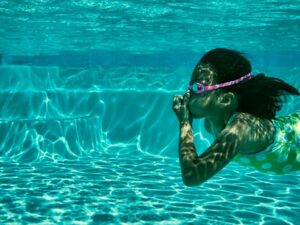
Natural swimming pools: a sustainable alternative, free from chlorine
Chlorine and various other chemicals are coming under increasing criticism. Owners of public and private swimming pools are looking for sustainable, eco-friendly and health-conscious solutions.
For safe and healthy swimming, a natural swimming environment is recommended. Whilst it is not always possible to swim in the pristine waters of a mountain lake, there are now effective solutions available that transform a traditional swimming pool into a natural one.
Vitii’s biological filtration system paves the way for a healthier future. A future where swimming pools once again become a genuine pleasure, without posing any risk to health or the environment.
With biological filtration, the pool looks just like a traditional pool, except that the water is softer, clearer and contains no chemicals.
The water is treated using ultraviolet light and oxygen. It is stripped of impurities and sterilised. The advantage is that no residual disinfectant is left in the water. This is in contrast to chlorine, where bathers are immersed in the disinfectant itself. Thanks to Vitii, bathers are in natural water, just like in a mountain lake.
Vitii, a high-performance, health-conscious system for private and large-scale public swimming pools.
Find out more about the Vitii natural swimming pool
